A good crown goes unnoticed. They only see your tooth.
That is the standard. Not whether it looks good on its own, but that no one can tell which one it is. Good material is not enough for this – it requires a dental technician who characterizes each one individually, and a doctor who will not fix it permanently until you are satisfied.
When is a crown or bridge the right choice?
In these situations, crowns and bridges are the most predictable solution, proven for decades:
The tooth has a filling that is too large or is cracked
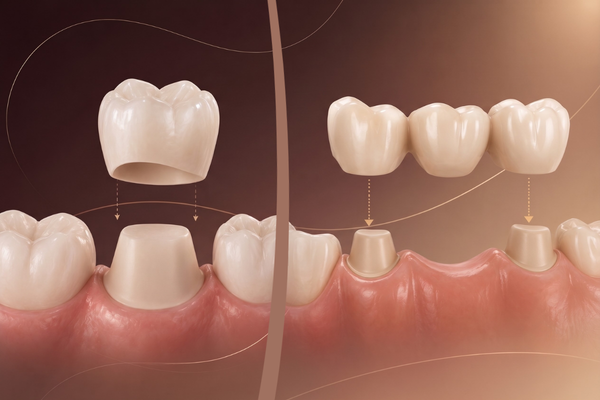
If a tooth consists more of a filling than its own material, it will crack sooner or later. A crown surrounds and supports it – this often saves the tooth from extraction.
An old crown or bridge needs to be replaced
The edges of old restorations discolour over time, and decay can start underneath. Replacement is not just an aesthetic issue: it protects the tooth underneath.
A missing tooth needs to be replaced
If the neighboring teeth need crowns anyway, a bridge is the obvious solution. But if they are healthy, it's worth considering an implant – we will discuss this honestly with you.
You want a harmonious, natural appearance
A well-designed crown doesn't give you a "new tooth", but restores what was yours – in shape, color, and light reflection.
When a bridge, and when rather an implant?
This is the most frequently asked question on this page, so we answer it openly. A bridge is cheaper and faster: ready in a few weeks. In return, the two neighboring teeth must be ground down – even if they are otherwise healthy.
An implant is more expensive and takes longer (several months), but the neighboring teeth are untouched, and the bone doesn't degrade at the gap. If the adjacent teeth need crowns anyway, a bridge is the logical choice. If they are intact, we generally recommend an implant – even if it is more expensive.
No assembly line – every work is unique
A five-step process with predictable timing – so you can plan your trip from abroad precisely.
Analysis and consultation
We start with an honest conversation. We look at the current situation and – more importantly – we listen to what matters to you: aesthetics, durability, or grinding as little as possible. The proposal is based on this.
Material and color selection
All-ceramic, zirconium, or metal-ceramic – each has its place. We clearly explain the difference, then we match the color exactly to your own teeth so the result goes unnoticed.
Gentle preparation and impression
The tooth is ground only as much as absolutely necessary. The impression can be taken traditionally or with a digital scanner – both lead to the same result: a perfectly fitting crown.
Temporary restoration
The final work is completed in the laboratory in 7 days. Until then, we protect the prepared tooth with a custom temporary: eating and speaking can continue unhindered – you don't have to take time off or cancel social events.
Final placement
During placement, we check the fit, bite, and appearance step by step. We only fix it permanently if everything is perfect – and if you are satisfied too.
Vienna quality, Hungarian price
For significantly less than the price of a treatment in Vienna, you get the same work – without compromise.
Custom craftsmanship
The dental technician characterizes each crown individually: translucency and shade are matched to real tooth enamel. This is the detail that makes it invisible.
Transparent price
With us, a crown or bridge unit is available from €250, with no hidden costs.
Written warranty
A 3-year comprehensive warranty on all crowns and bridges – subject to attending annual check-ups, which are free of charge with us.
What most people ask
Most often with zirconium oxide ceramic, because it is metal-free, durable, and natural-looking. All-ceramic is considered when aesthetics are most important – typically at the front. Metal-ceramic is used less often today, but it still has its place for back teeth under heavy load. We always tell you what we recommend and why.
With good oral hygiene and regular check-ups, usually 10–15 years, often longer. The most common reason a crown needs replacing is not the crown itself, but the condition of the tooth or gum underneath – which is why the annual check-up is important.
For a crown, we only touch the tooth that needs treatment anyway. For a bridge, the two neighboring teeth must also be ground down – this is why we say honestly that if they are healthy, an implant is often the better choice.
The final work is completed in the dental laboratory in 7 days. We bridge the intervening time with a temporary restoration, so you won't be without a tooth for a single day. For our patients arriving from abroad, we plan these 7 days so that you have to travel as infrequently as possible.
It is done under local anesthesia; you won't feel any pain during it. Afterwards, there may be slight sensitivity to heat or cold for a few days, which passes on its own.
Let's see what is realistic in your case.
Send us your existing scans or describe what bothers you. Within a few days, we will write back with what is possible, how long it would take, and what it would cost. Without obligation – the assessment is yours to keep, even if you ultimately don't choose us.